
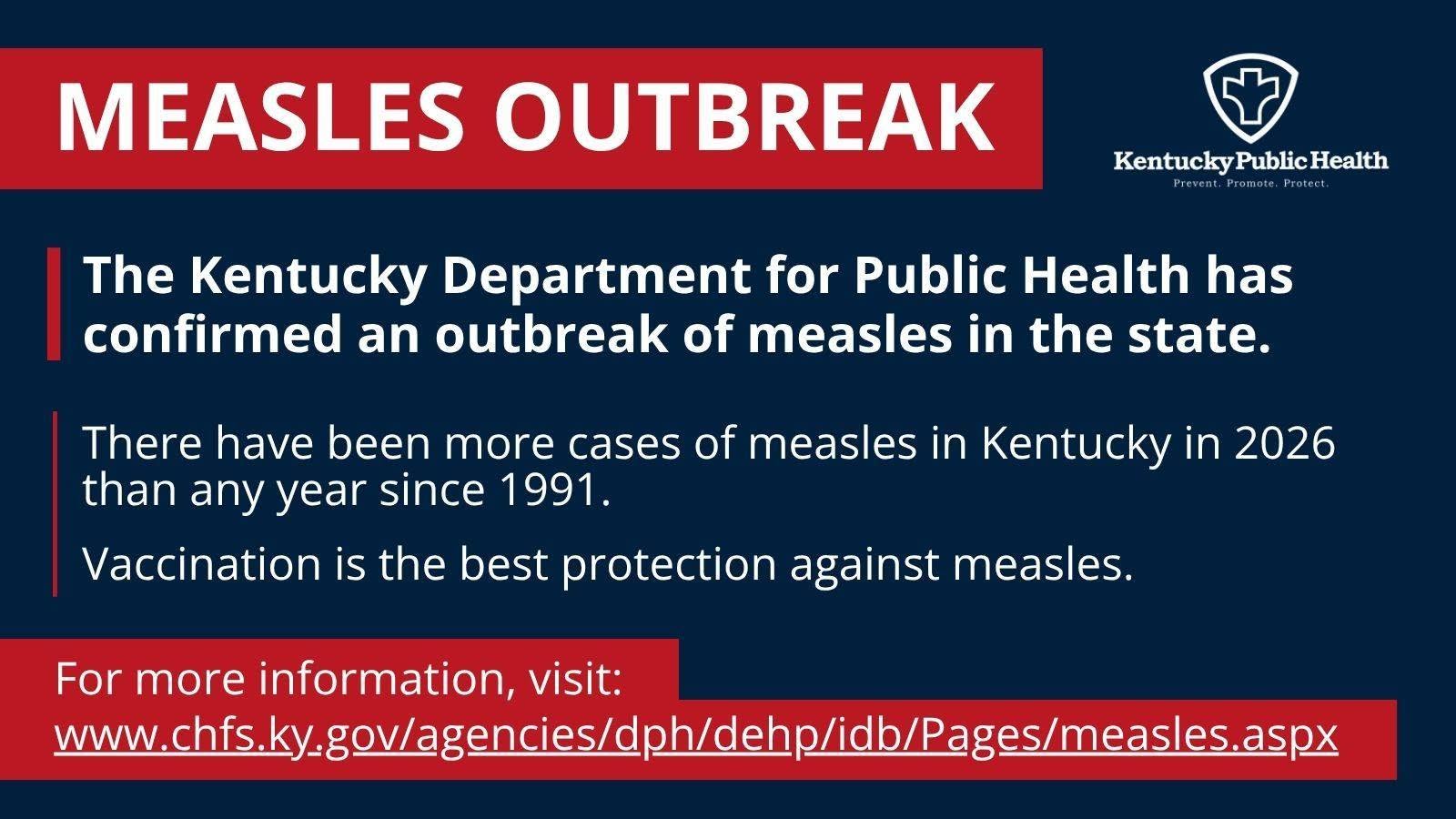
FRANKFORT, Ky. (Aug. 18, 2026) – Kentucky health officials have confirmed an ongoing measles outbreak in Kentucky and announced that the state has had more confirmed cases of measles in 2026 than in any year since 1991. Team Kentucky is reminding everyone that the best way to protect against measles is through the safe and effective vaccine.
“This is the largest measles outbreak Kentucky has experienced in many years,” said Cabinet for Health and Family Services Secretary Dr. Steven Stack. “Measles is almost entirely preventable for those who have had two doses of the measles, mumps, and rubella (MMR) vaccine, and we urge all parents and caregivers to make sure their children are immunized, so they are protected against this serious, sometimes life-threatening illness.”
The announcement follows confirmation of 15 cases in Western and Central Kentucky in the last four days. Those cases are in Christian, Owen, Todd, Trigg, and Washington Counties. Working with local health departments, the Kentucky Department for Public Health (KDPH) is actively investigating and expects case numbers and counties associated with the outbreak to increase. Four cases of measles were reported earlier this year in Jessamine County.
All 19 cases in 2026 have been in individuals who were not vaccinated against measles. Two people have been hospitalized.
Public health officials are working to identify sources of exposure, identify cases, and report all measles cases associated with the outbreak. Updated case counts are published each weekday by KDPH on the state’s measles dashboard.
A highly contagious respiratory virus, measles can also cause serious health complications, especially in young children. The disease is spread through the air, where it can remain suspended for up to two hours. Early symptoms of measles begin 8 to 12 days after exposure and include high fever, cough, runny nose, and red/watery eyes. The characteristic measles rash typically appears three to five days after symptoms begin, usually on the face before spreading down to the rest of the body.
The first dose of measles vaccine is routinely administered as part of the measles, mumps, and rubella (MMR) vaccine that should be given to children at age 12 months through 15 months at the earliest opportunity. A second dose should be given at age four years through six years. Together, these two doses of MMR vaccine are 97% effective against measles according to the American Academy of Pediatrics and other experts.
Some adults may need a second dose of MMR vaccine if they only received one previously or are uncertain of their vaccination status. This includes those traveling outside of the United States or those working in healthcare.
Immunization rates among Kentucky’s kindergartners have recently increased but are still below the national average. Results from the most recent school immunizations survey, for the 2025-2026 school year, indicate that only 90.7% of Kentucky kindergarteners are fully vaccinated against measles, which is lower than the national average of 92% in 2025-2026.
The U.S. is currently experiencing the largest measles outbreak since it was declared eliminated in 2000. As of Aug. 13, the CDC had reported more than 2,566 confirmed cases of measles across the country, the highest number of cases in a single year in 35 years. Prior to the most recent cases being identified this month, the last instances of measles in Kentucky were the four cases in Jessamine County in January.
For more information, visit http://www.chfs.ky.gov/agencies/dph/dehp/idb/Pages/measles.aspx or follow KDPH on social media.
###
Information on how the state is working to improve the lives and health of our people is available at CHFS.ky.gov. Follow the cabinet on Facebook, X, Instagram and LinkedIn.